Before Sputnik: The Mystery Lights That Refuse to Die
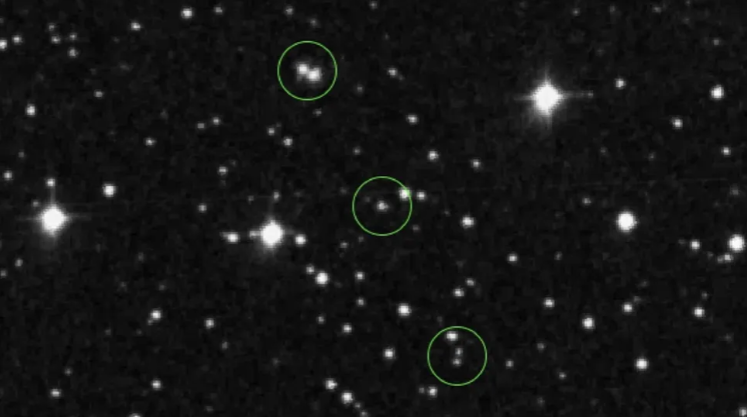
A new preprint has closed off the last refuge of the skeptics.
The strange lights on pre-Sputnik photographic plates carry a fingerprint that only a telescope can leave, and plate defects cannot fake it.
Written by Christopher Scott Carson - 7 July 2026
In the first week of June 2026, a retired NASA software engineer quietly published a paper that removes the last easy escape from one of the strangest claims in modern astronomy.
The claim, advanced over the past six years by the astrophysicist Beatriz Villarroel and her VASCO collaborators, is that photographic plates exposed in the 1950s, before any human object reached orbit, contain brief points of light that behave like reflections from objects that should not have been there. Skeptics have always had a ready answer: old photographic plates are riddled with defects, and a dust speck or chemical stain can counterfeit a star. The new paper, by Ivo Busko (arXiv:2606.08319), shows that a specific class of these transients carries the optical signature of coma, a lawful distortion that a telescope mirror imposes on light entering off-axis. A plate defect knows nothing of the telescope’s optics. Light that passed through them cannot help confessing that it did.
In plain terms: for eleven of these mystery lights, Busko has demonstrated that they are images of light from the sky, not blemishes on the film. That does not prove what the light was. It does demolish the single most durable objection to the whole VASCO program, and it does so with object-level evidence, one image at a time, rather than the population statistics that skeptics have spent the past year contesting. This is why it matters, and why Villarroel’s critics now have a much harder problem than they had in January.
Light Through the Telescope
Busko spent decades at the Space Telescope Science Institute writing data-reduction pipelines for Hubble and the James Webb Space Telescope, instruments calibrated to fractions of a pixel. In retirement he turned to the VASCO results as an outside examiner, choosing his own data, his own telescope, and his own method, and posting his entire pipeline as open source so that anyone with a laptop can repeat it.
His earlier paper, from March, found the transients in plates from Hamburg Observatory’s 1.2-meter Schmidt camera, and rested on their image profiles being too narrow to be stars. That argument is sound but contestable, because a Schmidt camera produces such clean images that some genuine plate defects are also sharp and round, and the two can be hard to separate. The June paper turns the problem inside out. Instead of a telescope whose images are clean, Busko chose one whose images are informatively flawed: Hamburg’s 0.6-meter Doppel-Reflektor, whose parabolic mirror imposes significant coma on any light entering at an angle to its axis.
Coma smears a point of light into a small comet-like figure with a bright head and two symmetric wings trailing into a tail. The figure is lawful in every respect. It points toward the center of the plate, it grows in proportion to its distance from that center, and its shape and brightness stand in a fixed relationship to the genuine stars around it. For a defect to counterfeit this, it would have to fake the orientation, the scaling with field position, and the wing structure all at once, and a whole population of defects would have to fake all of it coherently across the plate. The odds against that are what the paper is built on.
From the APPLAUSE archive of digitized European plates, Busko assembled 407 usable plate pairs spanning 1934 to 1957, cut off at October 1957 so that no glint can be blamed on Sputnik or anything launched after it. Pairs share field, exposure, and emulsion; an object on one plate of a pair and absent from its twin, taken minutes later, is a candidate. After filtering against standard software, cross-checking the USNO and Gaia catalogs and the later POSS-II survey, and ruling out asteroids through the Minor Planet Center, eleven transients survived, each judged by eye against the coma physics and against neighboring stars of the same brightness.
Their star-equivalent magnitudes run from 11.9 up to 7.1, but those figures assume the source shone for the whole exposure, as a star does. If the events were brief, the true brightness was far greater. Busko’s own arithmetic: a tenth-magnitude transient lasting one second on a fifteen-minute plate was, for that instant, near magnitude 2.6, rivaling the brighter stars of the night sky. Three such events, the brightest in the sample, appear on a single plate from 4 March 1951, and the brightest of those shows saturation and halation, the halo of light scattered within the emulsion. Those are signatures of real light acting on film, and no envelope stain produces them.
One analysis shows the method doing work no profile statistic could. On the plate in question, every cataloged star sits at the apex of its own comatic wing, the point of peak intensity, exactly where the optics place it. When Busko overlays the catalog positions on the brightest transient, the two faint stars nearest it sit off-center, away from that apex. The transient is therefore not a misbehaving image of either star. The aberration becomes a coordinate system internal to the plate, and the transient declines to occupy the seat reserved for any known occupant.
The strangest feature is the clustering, which Busko handles with notable care. All eleven transients fall in just two small regions of sky, and all eleven fall between 1949 and 1953, even though half the plate pairs lie outside that window and show nothing. The tightest sequences are remarkable: on 8 February 1951 a vanishing transient is followed twenty minutes later by an appearing one in the same field; in April 1953 three transients appear within 45 arcseconds of one another, in the same field where a single transient had appeared four years earlier. The 1953 triple is narrower than nearby stars, which a critic could hold against it, but Busko notes that a sub-second flash escapes most of the atmospheric blur that broadens a long stellar exposure and so prints sharper, while still carrying the coma signature, which all three do, in the same orientation as their neighbors. Three independent defects conspiring in that orientation is far less likely than three brief flashes.
The caveats belong here in full, because Busko states them in full, and his candor is the reason to trust the rest. The identifications are visual; a quantitative, automated version is promised in a later paper. The sample of eleven is too small for the clustering to be assigned statistical significance. And the nuclear-test associations in this particular sample are genuinely mixed: three groupings fall close to atmospheric tests, but 1950 saw no tests anywhere on earth and produced two transients, and the lone 1949 transient precedes the first Soviet test by four months. A weaker author would have reported the hits and dropped the misses. The misses are in the paper, which is why the hits are worth weighing.
So the paper’s claim is narrow and, within its limits, very strong. These eleven images were made by light that went through the telescope. Busko says plainly that this does not by itself establish what the light was, and the honest reader holds the line where he draws it. What it secures is the premise on which everything else depends, the one the skeptics denied: that at least some of the transients are real images of the sky. Whether the sky held machines is the next question.
How We Got Here
The VASCO project (Vanishing and Appearing Sources during a Century of Observations) began in 2020, when Villarroel and colleagues cross-matched some 600 million objects between an old catalog and a modern survey and found roughly a hundred points of light that appeared in a single epoch and never returned. A 2021 paper found multiple transients appearing together within single exposures and ruled out micrometeorites as the cause. A 2022 Virtual Observatory search by Solano, Villarroel and Rodrigo turned up 5,399 unidentified transients in the first Palomar survey, a residue that survived every conventional astronomical explanation.
The central objection arrived in 2024, when Hambly and Blair argued that the transients’ image profiles were narrower and rounder than stars and so were probably emulsion defects. This was the strongest skeptical card, and it held for a year, until Villarroel, Solano and Marcy answered it in 2025 with optical physics: a sub-second flash on a long exposure does not accumulate the atmospheric blur that broadens a star, so it must print narrower. The narrowness the skeptics read as a defect is exactly what the flash hypothesis requires. The objection had mistaken a prediction of the theory for evidence against it.
Two 2025 papers carried the story into the press. Bruehl and Villarroel, in Scientific Reports, found transient detections 45 percent more likely on days within one day of an atmospheric nuclear test (relative risk 1.45, p = .008). A second paper, in Publications of the Astronomical Society of the Pacific, reported transients appearing in geometric alignment on single plates, one alignment reaching 3.9 sigma, and a deficit of transients inside Earth’s shadow at geosynchronous altitude, where sunlit objects cannot glint, registering at roughly 22 sigma against one model and 7.6 sigma against a more conservative one. The shadow deficit remains the most stubborn single datum in the whole affair, because it ties the population to the geometry of sunlight at a specific altitude, which no property of film chemistry has any business knowing.
The most serious critique came in January 2026, from Watters, Dominé, Little, Pratt and Knuth, several of whom build instruments for the rigorous study of anomalous phenomena and so cannot be waved off as reflexive debunkers. Working from a heavily filtered subset of the data, they reported no shadow deficit and argued that the alignment and nuclear claims rest on contaminated samples and uncertain plate times. Their underlying demand is fair: statistics computed over a catalog known to contain artifacts inherit the catalog’s impurities. The Villarroel team responded in February, revised in April, arguing that the critique confuses validating individual objects with analyzing the ensemble, that the filtered subset is not demonstrably cleaner, and that the null results carry no error bars. They also conceded, in print, that up to two-thirds of the full 107,875-object catalog may be false positives, while maintaining that the ensemble statistics were designed precisely to pull signal from a contaminated sample. The exchange reached a stalemate that more statistics seemed unlikely to break, which is exactly the gap that object-level physical evidence was needed to fill.
Three independent replications then arrived in quick succession, each from an unaffiliated researcher working alone. Busko’s first paper supplied physical replication from a different telescope and hemisphere. Brian Doherty, a financial-services data analyst, replicated the nuclear-timing correlation and the shadow deficit with code written from scratch. Kevin Cann, an independent researcher in California, found that transient detections track the geomagnetic environment. (One disclosure: Doherty has since joined the Villarroel group as a co-author on a 2026 machine-learning paper. His replication predates that collaboration, and his code remains public, but readers should weigh his later work as a team member’s rather than an outside auditor’s.) Busko’s June paper, the coma analysis above, is the latest and, for the artifact question, the most decisive of these independent contributions.
The shape of the argument as of mid-2026 is this. Nobody disputes that the catalogs contain artifacts; the Villarroel team has conceded as much. The live question is whether, beneath the contamination, a real population of sub-second optical events exists. The ensemble statistics say yes; the critics say the ensembles are impure. Busko’s coma result bears directly on that deadlock, and it does so without using ensemble statistics at all.
The Statistical Replication
Busko’s work answers whether the transients are real. Doherty’s answers whether the patterns are real. His chi-square analysis reproduced the original nuclear result exactly (relative risk 1.45, p = 0.011). A negative binomial regression controlling for precipitation, moonlight, and cloud cover strengthened it to an incidence rate ratio of 1.80. And when he restricted the analysis to transients in sunlit sky positions, where reflection is physically possible, the ratio nearly quadrupled to 3.98, matching the original paper’s prediction that the signal should live where the sunlight lives.
A permutation test addressed the obvious objection that any cluster of dates might show elevated rates. Doherty shuffled the nuclear-window labels ten thousand times; the real result beat 99.4 percent of the shuffles (p = 0.006). His shadow analysis independently confirmed the deficit: 0.46 percent of transients fall inside Earth’s shadow against a geometric expectation near 1.4 percent, and the figure barely changes when plate edges are excluded, which rules out an edge artifact.
The Geomagnetic Replication
Cann cross-referenced the transient record against the standard index of geomagnetic disturbance, the planetary Kp index. His reasoning was direct: objects near geosynchronous altitude sit in the outer radiation belts, which respond to solar activity, so if the transients are real objects there, their detectability might track space weather, whereas film defects are indifferent to it. He found that detection rates fall steadily as geomagnetic disturbance rises, from 17.4 percent in quiet conditions to 2.4 percent in severe storms, a graded response unlikely to be chance (trend test p = 0.0007).
The analysis also kills a confound. If nuclear-test dates happened to fall in quiet geomagnetic periods, the nuclear correlation might be an artifact of space weather. They do not; test days lean slightly toward disturbed conditions, the very conditions that suppress detection. When Cann controlled for both Kp and lunar phase, the nuclear signal strengthened rather than weakened, from 2.6 sigma to 3.1 sigma. That pattern recurs throughout this story: each new layer of scrutiny applied to the nuclear signal has made it stronger, not weaker. Artifacts fade under examination. Real effects do not.
What the Nuclear Correlation Does and Does Not Say
The nuclear-timing result is easy to misread, in both directions. It is not the claim that detonations somehow created the transients, and it is not the claim that the tests drew visitors from afar. The claim is conditional and modest: when tests happened, detections rose. A relative risk of 1.45 over a nonzero baseline says only that something about the test windows raised the rate. It is a claim about response.
And a claim about response carries a consequence that, oddly, no one in the debate has stated plainly. A detection-rate response within a day of a Nevada test is available only to an observer already in place. Nothing outside the solar system could register a detonation and react, or even retask a sensor, within twenty-four hours; physics forbids it, and even something parked at the edge of the solar system would be four months away by light alone. So if the correlation is real, then whatever produced those elevated rates was already in near-Earth space before the shots that occasioned them. The tests cannot have attracted anything from outside. They can only have been noticed by something already here, whose attention sharpened afterward. The same timing that establishes the correlation establishes the residency.
Nor is a system that watches for nuclear detonations an exotic idea. From orbit, an atmospheric blast is almost insultingly easy to detect; the optical double flash is the very signal the later Vela satellites were built around. A surveillance architecture keyed to that signal is what we ourselves built within fifteen years. Read this way, Busko’s awkward cases switch sides. Two transients in 1950, a year with no tests at all, and a 1949 transient that precedes the first Soviet test, are fatal to any model in which tests are the sole trigger, but they are exactly what a standing presence looks like: attention that rises with provocation and persists without it. The counterexamples to “tests cause transients” are confirmations of the claim actually on the table, that there is a baseline and the tests modulate it. What the data cannot accommodate, on pain of breaking relativity, is a presence that was somewhere else when the tests began.
The Skeptical Case, and What Survives It
The strongest version of the skeptical case, drawn from the published record, runs as follows. The catalogs are admittedly contaminated, by the team’s own concession, and ensemble statistics over an impure sample require confidence that the impurity is random. Single-epoch detections can never be re-observed, so a program built on them must clear a higher bar. The pipelines have not been shown to recover known objects, such as modern satellites, in comparable data, an absent positive control. Several key papers, including the replications, remain unrefereed preprints, and one independence claim has lapsed into collaboration. And even granting every detection, real flashes in pre-Sputnik skies could in principle be some unrecognized natural phenomenon rather than machines.
Parts of that case stand. What no longer stands is the first and load-bearing claim, the one on which Hambly and Blair built everything and on which the Watters critique quietly depends: that the transients might be nothing but plate artifacts. The coma result is object-level evidence, immune to every quarrel about sample purity and plate times, because it uses no samples or plate times. The skeptic who wants to keep the artifact thesis must now explain how film chemistry learned the focal geometry of a parabolic mirror, oriented itself toward plate center, scaled with field position, saturated and haloed like real light, and declined to sit at the catalog positions of nearby stars. That case has not been made, and the burden has visibly changed shoulders.
The honest residue is the last point: the transients are real, and we do not yet know what they are. That is far less ground than the skeptics held in January, but it is real ground, and the instruments that could settle it are within reach.
Convergence
Independent replication is how science separates a real signal from one instrument’s quirk. When different groups, using different instruments, methods, and data, reach the same result, the chance that all were fooled the same way collapses. Emulsion defects? Different emulsions, manufacturers, decades, and three telescopes. Scanner artifacts? Different scanners and facilities. A catalog-matching fluke? Busko uses no external catalogs. One telescope’s optics? Three telescopes, and in the latest case the optics themselves now testify for the prosecution. An artifact is specific to the system that makes it; a signal that survives being moved between systems has forfeited the name.
The structure now has five strands. Busko supplies physical replication twice, narrow profiles on one telescope and the coma signature on another. Doherty supplies statistical replication of the nuclear timing and the shadow deficit. Cann supplies the geomagnetic dose-response. And the internal coherence supplies the fifth: the near-quadrupling of the nuclear signal in sunlit positions is predicted by the reflection hypothesis and by nothing else. Each strand answers a different objection. All point the same way: toward point sources consistent with sub-second flashes, distributed with respect to Earth’s shadow, correlated with nuclear tests in a way that survives every control, coupled to the radiation-belt environment, and appearing in skies that predate every human satellite. The evidence lends serious support to the hypothesis that reflective objects of non-human origin occupied near-Earth space before the Space Age began.
An Illustrative Tally
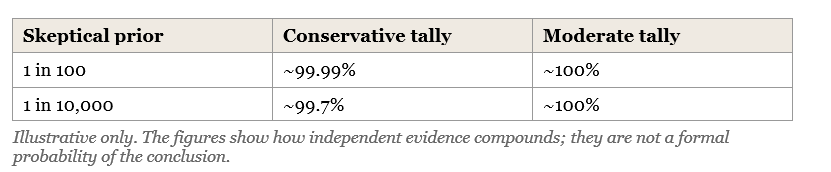
What follows is a heuristic, not a proof, and it should be read as one. Bayesian reasoning offers a way to see what happens when several independent lines of evidence are combined, and the exercise below is a deliberately rough illustration of that structure, not a formal calculation from first principles. The numbers are informed judgments; reasonable people will assign different ones; the point is the shape of the result, not its decimal places.
The method is simple. For each line of evidence, one asks how much more probable it is under the artificial hypothesis than under any conventional explanation, and multiplies those factors together, which is valid only to the extent the lines are genuinely independent. Six lines bear on the question: the narrow image profiles, the shadow deficit, the nuclear-test timing, the concentration of that timing signal in sunlit positions, the geomagnetic dose-response, and now the coma signature. The coma line deserves the most modest weight of the six, despite its force, because it separates real light from artifact without separating machines from some unknown natural source; its main effect is to remove the artifact branch on which the skeptical case has chiefly stood.
Even on deliberately conservative weightings, the combined factor runs into the millions, and on moderate ones into the hundreds of millions. Applied to a skeptical starting point of one chance in a hundred, or even one in ten thousand, the result lands near practical certainty in every case. The lesson is not the specific number, which no one should take literally, but its insensitivity to the starting point and to the exact weights, which is the hallmark of several independent lines pointing the same way. The real force of the argument is qualitative: because the lines are orthogonal, no single alternative explains them jointly. The artifact reading is now contradicted by the coma; an atmospheric reading cannot explain the sunlit amplification; a debris reading fails the geomagnetic response. The natural explanations fragment, and the artificial hypothesis is fed by the very evidence that breaks them.
Where Are They Now?
The obvious objection is that if such objects existed, modern surveys would see them. They would not, because no one has run the right search. Robert Freitas calculated in 1985 that near-Earth space is 99.9999 percent unexplored for objects in the one-to-ten-meter range, and that remains roughly true. A mirror-finished ten-meter probe at a quarter of the Earth-Sun distance would register at magnitude 21, near the edge of visibility; darker or smaller, it vanishes. The satellites that watch geosynchronous orbit track known, cataloged objects, not unknown ones.
Worse, the surveys use the wrong paradigm. Asteroid surveys look for objects that move against the stars; a geosynchronous object sits still and is filed as a star. Transient surveys look for events lasting hours to weeks; a sub-second glint registers as a single-frame blip and is discarded as a cosmic-ray strike. Space surveillance looks for the streaks that low-orbit objects leave; geosynchronous glints leave none. Every major detection method in use is tuned to reject exactly this kind of signal. And the objects themselves may have changed: seventy years of space weathering darkens metal by orders of magnitude, so probes that glinted in 1951 may now be too dim to see, or may have moved, gone dormant, or left. Vast stable niches, the Lagrange points and the graveyard belt above geosynchronous orbit, where a probe would share space with five hundred dead satellites nobody examines, have never been searched. If you wanted to park something unnoticed, those are the addresses you would choose.
The Decision to Look
The gap is one of instrument design and priority, not physics, and the tools exist or are close. The most direct proposal is ExoProbe, a Villarroel-led concept for a network of telescopes watching the same sky at once, so that a real flash appears in several instruments and can be triangulated for altitude and checked spectroscopically for reflected sunlight, while cosmic rays and single-instrument noise are rejected in real time. A complementary method, already demonstrated with Zwicky Transient Facility data in a 2026 paper, uses Earth’s shadow as a filter, since anything self-luminous found inside the shadow cannot be a sunlit satellite. Existing archives can also be re-mined, and Busko has now shown two independent ways to do it, with a pipeline anyone can download and a vast backlog of plates still unsearched.
The question is no longer whether the transients are real. Two physical replications, one from image shape and one from the optical signature of coma, together with independent statistical and geomagnetic replications, have settled that for anyone willing to weigh evidence over reputation. The narrow profiles are not a Palomar artifact.
The shadow deficit is not a statistical mirage. The nuclear correlation has sharpened under three rounds of adversarial scrutiny. And eleven images from a parabolic mirror in Hamburg carry the one credential no defect can forge: the telescope’s own handwriting.
What remains is to find out what the light was, and that is answerable. The plates are digitized and waiting. The only missing ingredient is the decision to look, and after five convergent lines of confirmation, choosing not to look is itself a position, one that will increasingly need defending.
Note: References from this article can be found here.